Generative AI: The Double-Edged SWORD Reshaping Innovation Forever
Generative AI: The Double-Edged Sword Reshaping Innovation Forever Imagine waking up tomorrow to find that a computer has written a bestselling novel, composed a hit song, and designed a groundbreaking product overnight. This may sound like science fiction, but it’s the reality of Generative Artificial Intelligence. Machines are not just following commands; they are creating original content from scratch. Generative AI has emerged like a technological tsunami. It is fundamentally changing how we view creativity, innovation, and human ability. From ChatGPT writing emails to DALL-E producing impressive artwork, these AI systems are challenging our understanding of creativity. But here’s the big question that keeps innovators, artists, and business leaders awake at night: Is this amazing technology our best ally in pushing human achievement, or is it the start of the decline for true human innovation? This intriguing debate is not just an academic discussion in university hallways. It is taking place in boardrooms, art studios, and research labs across the globe. Some people are thrilled, calling generative AI the ultimate creativity booster that will enable humans to accomplish things they never thought possible. Others are raising concerns, fearing that we might be creating our own replacements and potentially hurting the core of human creativity. In this exploration, we will examine both sides of this heated discussion, look at real-world examples, and try to understand whether generative AI is truly a blessing or a curse for innovation. Prepare to challenge your views and discover why this topic may be one of the most important conversations of our time.
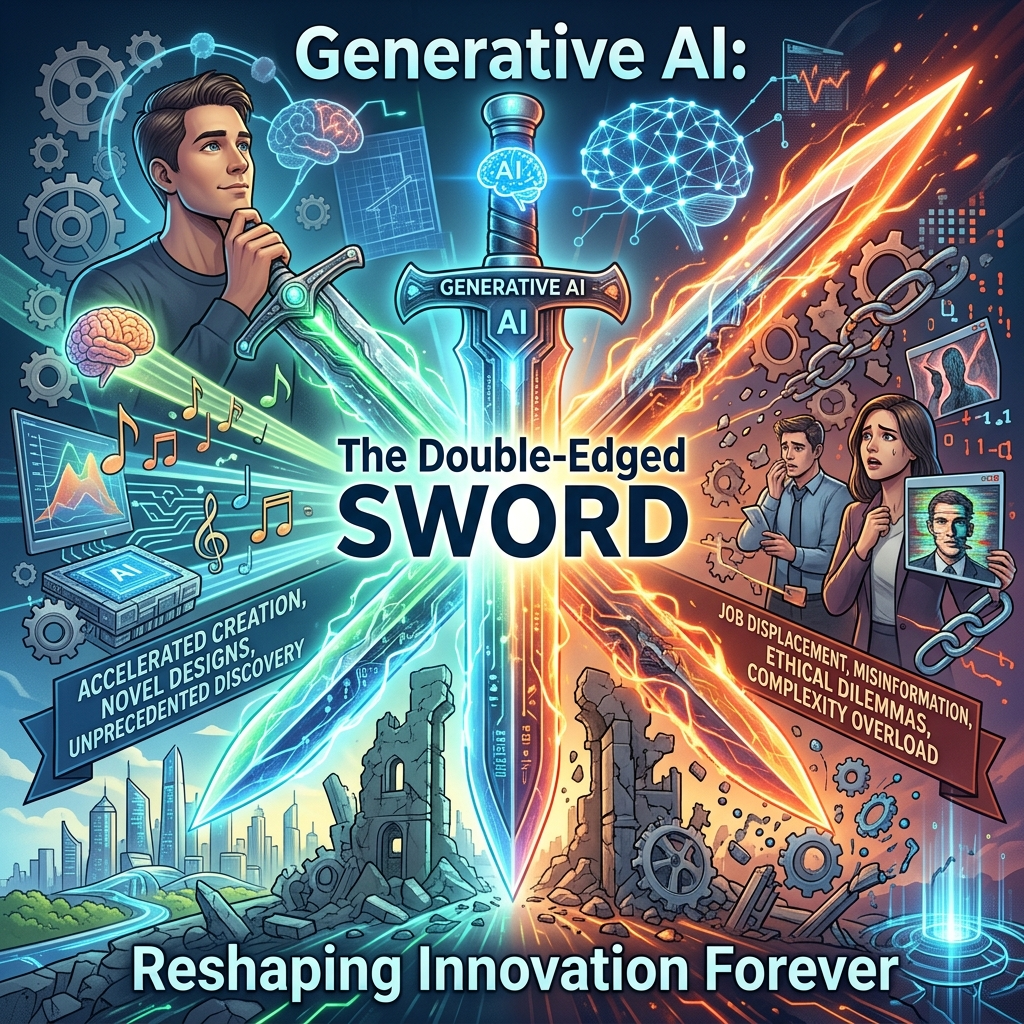
The BRIGHT Side: The Benefits of Generative AI in Supercharging Innovation
Now, on to the good stuff! Generative AI is like providing each person on the face of the Earth with their own personal team of super-genius personal assistants who work 24/7, never complain, & can help you accomplish almost anything. Let’s be real, when’s the last time you got a chance to brainstorm ideas with someone who has read nearly every book ever written, examined millions of images, & can combine ideas in ways you might not even be able to think of on your own?
One of the AMAZING things about generative AI is its potential to democratize innovation. Don’t you remember when it took millions of dollars & a crew of hundreds of people to make a movie? Now, independent filmmakers are using AI tools to create incredible visual effects, write compelling scripts, & even create background music. Sarah, a college student from Ohio, has recently created an entire animated short film using a variety of AI tools, something which would have been impossible for someone without access to a professional team just five years ago.
The speed at which innovation is now happening is just mind-blowing. Scientists are now discovering new drug compounds with the help of generative AI in just months, where it would have previously taken years. Engineers are now able to create new, more efficient engine designs by letting AI create thousands of design variations. Artists are now able to create new forms of art with the help of AI. It's like we've finally figured out how to fast-forward past the boring parts of being creative and get to the good stuff, like thinking about the big-picture ideas.
But perhaps the most INCREDIBLE thing about this is how generative AI is able to solve the "blank page" problem. You know, when you're staring at a blank document, unsure of where to even begin? Well, AI is able to create initial drafts, suggest improvements, and solve creative blocks that have plagued humans for centuries. Writers are now able to use AI to brainstorm new story ideas, designers are able to create hundreds of different logo designs in just minutes, and musicians are discovering new melodies they would have never thought to create on their own.
The DARK Side: When Innovation Faces Its Greatest Challenge
However, not all is rosy in the world of AI creativity. In fact, some pretty scary questions are being raised by those who are skeptical about AI creativity. What happens to human creativity when machines can create content faster, cheaper, & better?
The most obvious concern is that AI creativity can take away jobs. Graphic designers are seeing AI create logos in seconds that can take them hours to create. Writers are seeing AI create articles, stories, & poetry that can rival human creations. Musicians are seeing AI create symphonies that can take away human creations. But it is not just jobs that are at stake here; it is the value of human creativity that people have spent years developing.
And then there is the problem of ORIGIMALITY. Is AI really being ORIGIMAL when it creates new work by analyzing and combining existing human work, or is it just becoming the world’s most sophisticated COPY MACHINE? Some artists even accuse AI of STEALING their work, using their styles without permission, and then competing against them using their own creative DNA. “Imagine you spent decades finding your own voice as an artist, only to have AI replicate it perfectly in a matter of minutes.”
The problem of DEPENDENCY is also CONCERNING. Are we losing our own CREATIVE CAPABILITIES as we increasingly depend on AI? It’s like using GPS everywhere and then realizing you can’t even navigate anymore without it. Some educators even fear that children who grow up using AI might not develop strong independent thinking skills.
But perhaps most disconcerting is the possibility of creative homogenization. Will we not see a point where all creative works look similar because everyone is working with similar AI tools built on similar data sets? Will we lose the rich beauty of human perspectives, cultural differences, & individual quirks that make creativity so rich & meaningful?
Finding the SWEET Spot: A Balanced Perspective on AI & Innovation
So, what does all this mean to us? Well, the truth is that generative AI is neither all blessing nor all curse – it’s a powerful tool that will shape the future of innovation based on how we use it. The key to all this is to get the right BALANCE between harnessing the power of AI and preserving what makes human creativity special.
Smart innovators are already working out how to use AI as a collaborative tool rather than a replacement. They’re working with AI as an ‘incredibly sophisticated brainstorming buddy’ that can help generate ideas, give feedback, and get mundane tasks done so that humans can get on with the high-level creative decisions, emotional storytelling, and thinking. This is the best of both worlds!
A good example to illustrate this is the film industry. Nobody is talking about replacing film directors with AI; instead, they're using AI to help them pre-visualize scenes so they don't have to waste money on shooting scenes that might not work. They're also using AI to come up with different script options so they can explore different possibilities. While the AI does all the heavy lifting, the human decides what's best in the end. That's what matters.
The education sector is also embracing AI in a positive way. Nobody is talking about banning AI in schools; instead, some innovative teachers are teaching their students how to use AI in a way that's productive. They're also teaching their students how to think critically.
We're also seeing the emergence of new creative fields that didn't exist before AI. Prompt engineering – the art of communicating effectively with AI systems – has become a valuable skill. AI art direction, where humans guide AI through complex creative projects, is creating entirely new career paths.
The Road Ahead: Navigating Innovation's AI-Powered Future
As we find ourselves at this crossroads in history, it is very clear that this technology is not going anywhere. The debate is no longer whether we are going to be impacted by this technology in innovation, but rather how we are going to not only adapt to it but thrive with it. The most successful individuals, organizations, and societies will be those who are able to harness this technology to its full potential while maintaining our humanity.
The future of innovation is going to be in COLLABORATION, not competition, with AI. We are going to need to create new frameworks for creative collaboration with AI technology, create a new set of ethics around AI technology, and ensure that we are not replaced by it but are enhanced by it.
We should also remember, however, that innovation is not just about making content, but about solving problems, meeting human needs, and pushing boundaries in important ways. AI may help us think up new ideas and execute them quickly, but it is our wisdom, our humanity, that will help us decide which problems are important to solve and how to solve them effectively.
What kind of role will you play in this new world of AI? Will you seize this new technology and use it to create new and wondrous things, or will you fear change and be left behind? The choice is yours, but one thing is certain: the future of innovation belongs to those who understand how to marry artificial intelligence with human ingenuity. The debate over whether AI is a boon or a curse to innovation is beside the point; the real debate is whether we have the wisdom to make it the boon it has the potential to be.