UNDERSTANDING “GROUP DISCUSSION AND DEBATE”
Growing up, participating in debates and group discussions in my school has helped me express myself clearly and confidently. I remember my first group discussion, where I was too nervous to speak in front of others, worrying whether my points were good enough. And the same goes for debate, but over the years, participating in more debates and group discussions has profoundly shaped the way I think, communicate, and express my ideas confidently. Both group discussion and debate are common ways to communicate ideas, but they serve different purposes. So understanding them can help us to choose the right approach and improve our communication skills. So, let's begin with a group discussion.
GROUP DISCUSSION
Group discussion is a process of exchanging different ideas, perspectives, and viewpoints among a group of people on a specific topic in a structured manner. This usually takes place in a formal setting in the presence of a facilitator or panelist to guide the process by providing structure, managing time and neutrality in the discussion. It is comprehensively used in academic settings and recruitment processes to assess the communication skills, teamwork, leadership quality, and problem-solving ability of participants. It also helps to assess a participant's awareness and acceptance of others' viewpoints.
Group discussions are usually conducted between 6-12 participants who discuss the topic for 25-30 minutes.

Before the Discussion:
Panelists give instructions, any guidelines, or rules to follow during the discussion. Then a topic is given by the panelist, which can be from current affairs, abstract, social issues, or opinion-based. Participants are given 2 to 5 minutes to organise their thoughts or ideas about the topic prior to the commencement of the discussion.
commencement:
As the discussion initiates, each participants begin to share their ideas, facts, or opinions in turn.
(Note: Try to initiate the discussion as the first speaker sets the tone, so initiating is often valued.)
main discussion:
Participants present their views, add on to the thoughts of others politely with valid examples or evidences.
(Note: Speak clearly and to the point.
Don’t counter others frequently and aggressively.
Listen actively and build your own opinion or ideas through it.)
summary:
In the end, the panelist asks for a summary where one or two participants summarise the key points of the discussion.
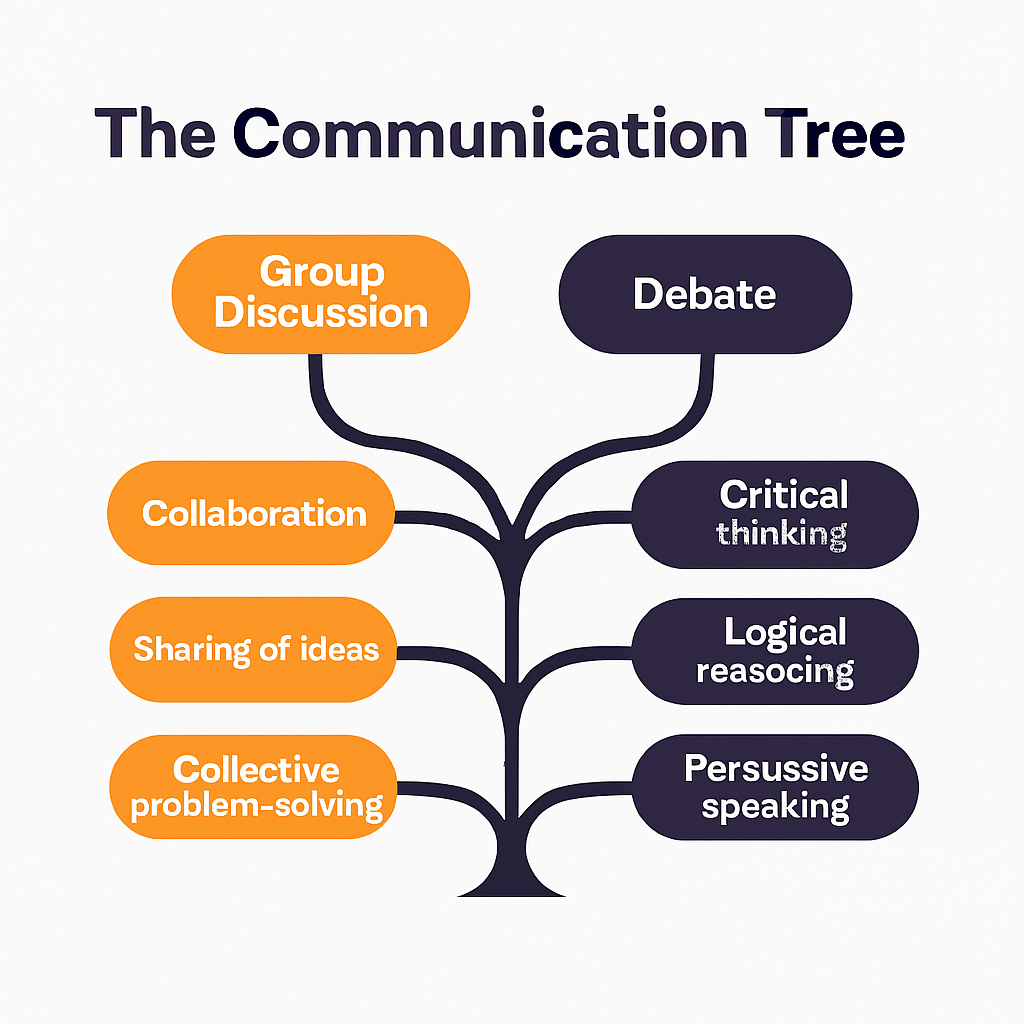
In essence, Group discussions promote collaboration, active listening, and collective problem.
DEBATE
A debate is a formal or informal discussion between people where they express their opposing ideas or views on a specific topic or statement. A debate has two sides, i.e, opposition and motion.
- Opposition: Against the idea or statement
- Motion: Supports the idea
Both sides, either opposition or motion, should be backed with proper reasoning, logic, facts, and evidence.
Debate can happen in both formal and informal settings, such as academic competition, political debates, between friends or a general discussion on any matter. It enables an individual to foster critical thinking, improve communication skills, and increase awareness and knowledge. It instils a sense of teamwork and develops the skill of convincing the audience or judges through well-supported arguments. It teaches disagreeing without being disrespectful and builds the confidence of presenting arguments in front of an audience. In academic, social, or political contexts, debates help weigh the pros and cons before arriving at a decision.
 A debate can be conducted between two or more individuals. In a formal setting, a debate has a moderator/judge and an audience to observe the participants.
preparation:
A topic is introduced by the moderator/judge in the beginning, and participants are divided into two teams- Affirmative(motion) and opposition. Both teams are given 2 to 5 minutes beforehand to organise their thoughts and prepare their points.
presentation:
Each side begins with presenting its argument. One speaker from each side starts by expressing their main argument. One speaker from each side starts by expressing their main points and their stand within a fixed time limit. Speakers take turns to present their points with supporting evidence.
rebuttal:
After the presentation of their primary argument, each team confronts the opposing side's points by interrogating, contesting, or refuting the claims made by their opponents.
Summary/Decision:
Ultimately, the debate ends with each side presenting a final summary speech, highlighting their key argument and delineating the reasons they deserve to win.
Debate sharpen critical thinking, logical reasoning, and persuasive speaking. They teach us how to disagree respectfully and back our stance with facts and clarity.
GD VS DEBATE: WHICH IS MORE EFFECTIVE?
Both group discussions and debates are significant forms of communication, but they serve different purposes. A group discussion highlights collaborating, sharing of ideas, and collective problem-solving, where listening, cooperation, and agreement are important. On the other hand, a debate focuses on critical thinking, logical reasoning, and persuasive speaking, where participants convince others of their views and challenge opposing arguments.
In short, group discussions build teamwork and open-mindedness, while debates sharpen reasoning and argumentative skills. Depending on the context—whether the goal is to reach a solution or to test viewpoints—each method is effective in its own way.